
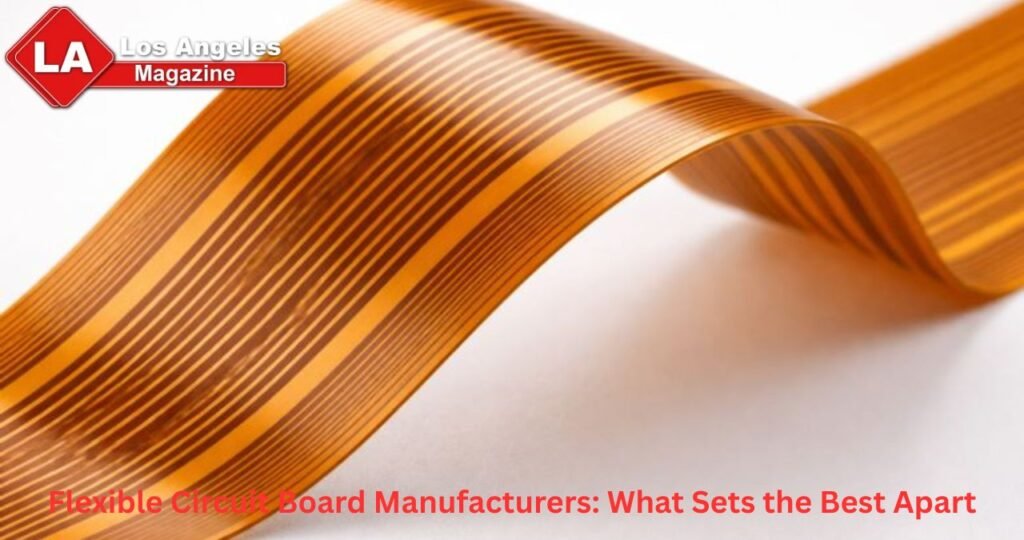

Not all flexible circuit board manufacturers are equipped to handle the full range of flex PCB applications. Flexible circuits require different substrate materials, different lamination processes, different handling disciplines during assembly, and different quality verification methods than rigid boards. A factory that builds high-quality FR4 multilayer boards does not automatically have the capability to produce reliable flex or rigid-flex circuits. The differences go deeper than material substitution.
This article covers what separates capable flexible circuit board manufacturers from those who offer flex as a side capability, what materials and processes are involved, what design decisions most affect manufacturability and bend life, and what to verify before placing an order.
What Flexible Circuit Boards Are and Where They Are Used
A flexible circuit board is a printed circuit board built on a flexible substrate, typically polyimide, that allows the board to bend, fold, or twist without breaking. Unlike standard FR4 boards, which are rigid and will crack if flexed, flex PCBs are designed to move. The substrate, the copper foil, and the protective coverlay are all chosen to withstand repeated mechanical deformation without electrical or mechanical failure.
Flex circuits are used wherever a rigid board cannot fit, where weight must be minimized, where the board must conform to a curved surface, or where the circuit must flex dynamically during the product life. Common applications include smartphone cameras and display connectors, wearable health monitors, hearing aids and cochlear implants, industrial robotics arm connections, automotive dashboard electronics, satellite attitude control systems, and military avionics where weight and space are tightly constrained.
The market divides flex circuits into two broad categories: static flex, where the board is bent once during assembly and stays in that position for its service life, and dynamic flex, where the board bends repeatedly during normal product operation. The design rules and material requirements differ significantly between the two, and a capable manufacturer needs to understand which you are building before advising on stack-up and trace geometry.
FastTurn PCB manufactures flexible PCBs from single-layer through multilayer constructions, including HDI rigid-flex combinations. Their flex production supports quick-turn prototyping in as fast as 48 hours and scalable production with batch sizes from one board to volume production runs.
Materials Used in Flexible Circuit Board Manufacturing
The materials that make up a flex PCB are fundamentally different from those in a rigid board. Each layer of the flex stack-up must contribute to the electrical function while maintaining mechanical flexibility and long-term reliability through repeated bending.
Polyimide substrate
Polyimide, often known by the DuPont trade name Kapton, is the standard base material for flex circuits. It is a thin, dimensionally stable, thermally resistant polymer that maintains its mechanical and electrical properties across a wide temperature range, typically minus 65 to plus 260 degrees Celsius continuously. Polyimide has a dielectric constant of approximately 3.4, stable across frequency, and a dissipation factor low enough for most flex circuit applications below 5 GHz.
Standard polyimide thicknesses used in flex PCB production are 12.5 micrometers, 25 micrometers, 50 micrometers, and 75 micrometers. Thinner substrate bends more easily and has a smaller minimum bend radius, but is more fragile during handling and assembly. The choice of substrate thickness is one of the most important decisions in flex circuit design and depends on the bend radius, the number of flex cycles expected during product life, and the mechanical constraints of the assembly.
FastTurn PCB uses high-grade polyimide from qualified suppliers for all flex PCB production. Polyester substrate is also available for cost-sensitive applications where temperature requirements are modest, though polyimide is the standard for any application requiring soldering, high operating temperature, or long dynamic flex life.
Rolled annealed copper foil
The copper used in flex circuits is not the same as the copper used in rigid PCBs. Standard electrodeposited copper foil, which is used in most FR4 multilayer boards, has a columnar grain structure that makes it relatively brittle when flexed. Repeated bending causes the copper to work-harden and eventually crack.
Rolled annealed copper foil is produced by rolling copper to the required thickness and then annealing it, which recrystallizes the grain structure into a flatter, more ductile orientation. RA copper bends and stretches without cracking far more effectively than electrodeposited copper under the same conditions. For any dynamic flex application, RA copper is required. For static flex applications, electrodeposited copper is sometimes acceptable depending on the bend radius and the number of assembly flexing cycles.
FastTurn PCB uses rolled annealed copper foil in their flex PCB production to ensure excellent bendability and long flex life. Standard copper weights for flex circuits are half ounce and 1 ounce, with thinner copper used where tighter bend radii are required.
Adhesiveless laminates
Traditional flex laminates bond copper foil to polyimide using an acrylic or epoxy adhesive layer. Adhesive-based laminates are less expensive but introduce a material with different thermal expansion, lower continuous service temperature, and lower dimensional stability than the polyimide itself. For high-reliability applications, adhesiveless laminates are preferred. In an adhesiveless laminate, the copper is deposited directly onto the polyimide without an intermediate adhesive layer. This produces a thinner, more dimensionally stable, higher-temperature capable construction. FastTurn PCB uses adhesiveless laminates for high-reliability flex applications.
Coverlay
Coverlay is the protective outer layer applied to a flex circuit in place of soldermask. While rigid boards use liquid photoimageable soldermask that can be patterned by photolithography down to very fine feature sizes, coverlay is a preformed film of polyimide with adhesive backing. The openings for component pads are routed or laser-cut into the coverlay before it is laminated onto the flex circuit.
Coverlay provides better flexibility and adhesion than liquid soldermask on a flex substrate because it is itself a flexible polymer film that moves with the circuit during bending. Liquid soldermask cracks on flex circuits that undergo significant bending. Coverlay opening tolerances are wider than soldermask opening tolerances because routing and laser cutting are less precise than photolithography. Component pads on flex circuits should be designed with this in mind, keeping coverlay openings as large as your component footprint allows.
Stiffeners
Flex circuits are often designed with stiffeners attached in areas where components are soldered or where connectors are inserted. A stiffener is a rigid backing material, typically FR4 or stainless steel, bonded to the back of the flex in the connector or component area. It prevents the flex from deflecting during component insertion or mating, which would otherwise stress the solder joints or the connector contacts.
Stiffeners are attached using pressure-sensitive adhesive or thermally bonded adhesive film. The stiffener area must be carefully defined in your design files because it affects the flex circuit routing and the component placement constraints. FastTurn PCB applies stiffeners as part of the standard flex fabrication process, with FR4 and stainless steel stiffener options available.
Flex PCB Construction Types
Flexible circuits come in several construction types, each suited to different application requirements.
Single-layer flex
One copper layer on a polyimide substrate with coverlay on one or both sides. The simplest and least expensive flex construction. Used for simple interconnects, antenna traces, and sensor leads where only one routing layer is needed. Single-layer flex can achieve very tight bend radii and is suitable for high-cycle dynamic flex applications.
Double-sided flex
Two copper layers on a polyimide core with coverlay on both sides. Allows routing on both sides of the substrate and supports plated through-holes connecting the two layers. Double-sided flex is more expensive than single-layer and has a larger minimum bend radius because of the additional copper and substrate thickness. Interlayer connections use plated through-holes or laser-drilled microvias depending on the pitch and density requirements.
Multilayer flex
Three or more copper layers laminated together with polyimide dielectric between each pair of layers. Used for complex circuits that cannot be routed on one or two layers. Multilayer flex is significantly thicker than single or double-sided flex and has correspondingly larger minimum bend radii. For designs that require multilayer routing but also need to flex, careful stack-up design is required to keep the neutral bend axis in the correct position and minimize stress on the copper layers during bending.
Rigid-flex
A hybrid construction combining rigid FR4 sections and flexible polyimide sections in the same board. The rigid sections carry components and connectors. The flex sections span between rigid sections, replacing wire harnesses or separate cable assemblies. Rigid-flex designs are used where a rigid board cannot fit in the available space, where multiple rigid boards would otherwise be connected by cables, or where the elimination of connectors improves reliability.
Rigid-flex manufacturing requires sequential lamination of the rigid and flex sections, careful management of layer transitions at the flex-to-rigid interface, and precise routing of the board outline. FastTurn PCB manufactures rigid-flex boards from simple two-section designs through complex multilayer configurations with multiple flex zones and HDI via structures.
Key Design Rules for Flexible Circuit Boards
Flex PCB design follows different rules from rigid PCB design. The differences are driven by the mechanical behavior of the flex substrate and copper during bending.
Minimum bend radius
The minimum bend radius is the tightest curve the flex circuit can be bent to without damaging the copper traces or the substrate. It is determined by the total flex thickness, the copper weight, and whether the application is static or dynamic. A common guideline is that the minimum bend radius for a dynamic flex application is 10 times the total flex thickness, and 6 times the total flex thickness for a static flex application that will be bent only once during assembly.
Thicker flex circuits require larger minimum bend radii. For a single-layer flex circuit 0.1 mm thick, a 1 mm bend radius may be achievable for static flex. For a multilayer flex 0.5 mm thick, the minimum static bend radius is approximately 3 mm. Violating the minimum bend radius cracks the copper and is the most common cause of field failures in flex circuits.
Trace routing in bend zones
Traces in the bend zone should run perpendicular to the bend axis, meaning they run parallel to the direction of the bend fold rather than across it. Traces running across the bend axis experience tensile or compressive stress during bending, which eventually causes cracking. Traces running along the bend axis experience far less stress.
In bend zones, use a hatched or reduced copper pour rather than solid copper fills. A solid copper pour in a bend zone stiffens the flex and concentrates stress at the edge of the pour, which can crack the copper or the substrate at the boundary. Hatched copper, with the fill reduced to a grid pattern at 45 degrees, provides ground coverage while allowing the substrate to bend more freely.
Via placement relative to bend zones
Vias and plated through-holes should not be placed in the bend zone. The via barrel is a rigid copper cylinder that does not flex, and placing vias in a bend zone concentrates stress at the via edge and causes cracking of either the via barrel or the surrounding copper pad. Keep all vias and holes at least 1 mm away from the bend zone boundary, with more distance for tighter bend radii or higher cycle applications.
Teardrops at pad entries
Where traces enter component pads or via pads, a teardrop fillet should be added to smooth the transition between the trace width and the larger pad. Without a teardrop, the sharp edge where the trace meets the pad creates a stress concentration point that can crack during bending or during the thermal cycling of reflow assembly. Most PCB layout tools can add teardrops automatically. FastTurn PCB recommends teardrops on all flex PCB pad entries.
Stagger traces in multilayer flex
In multilayer flex circuits, traces on different layers should not be stacked directly on top of each other in the bend zone. Stacked traces create a locally thicker and stiffer region that concentrates bending stress. Stagger traces laterally between layers so that the copper on each layer is offset from the copper on adjacent layers. This distributes the stiffness more evenly and reduces local stress peaks.
Anchor pads and strain relief
At the transition between the rigid stiffener area and the flex zone, traces crossing this boundary experience stress concentration at the coverlay edge. Add anchor pads or strain relief copper features at this transition to spread the stress over a larger area. Some designs use a short fan-out of traces from the stiffener edge into the flex zone before routing them to their final positions, which reduces the stress on any individual trace.
Quality Standards That Apply to Flexible Circuit Board Manufacturing
The primary quality standard for flexible circuit board manufacturing is IPC-6013, which covers qualification and performance specification for flexible printed boards. IPC-6013 defines requirements for materials, construction, electrical performance, and environmental testing at three class levels: Class 1 for general electronic products, Class 2 for dedicated service electronics, and Class 3 for high-reliability applications.
FastTurn PCB manufactures flex PCBs to IPC-6013 and IPC-A-600/610 Class 2 or Class 3 standards depending on application requirements. Every flex PCB order goes through 100 percent electrical testing, automated optical inspection, and reliability verification. Certifications covering flex production include ISO 9001, ISO 13485 for medical applications, RoHS, and REACH. Material traceability documentation is available upon request.
Flex-specific quality checks that differ from rigid board inspection include bend radius verification to confirm that no features are placed in the minimum bend zone, coverlay adhesion testing, dimensional inspection of the flex circuit outline and stiffener placement, and for dynamic flex applications, accelerated bend cycle testing to verify that the design meets the required cycle life.
What to Look for in a Flexible Circuit Board Manufacturer
Dedicated flex production line
Flex PCB production requires handling processes different from rigid boards. Polyimide substrate is significantly more dimensionally sensitive to temperature and humidity than FR4. Flex circuits are thinner and more fragile than rigid boards and must be handled on carriers or frames throughout production. A factory that runs flex circuits through the same production line as rigid boards, without dedicated carriers and handling procedures, will produce flex circuits with dimensional problems, registration errors, and surface damage.
FastTurn PCB operates a dedicated flex PCB production line with controlled handling throughout fabrication and assembly. Their assembly process includes controlled fixturing for SMT placement on flex circuits to prevent deformation during reflow, which is one of the most common causes of assembly defects on flex boards.
Material traceability and authorized sourcing
The polyimide and RA copper materials used in flex PCB production must come from qualified suppliers to ensure consistent electrical and mechanical properties. Ask your flex manufacturer to confirm which polyimide supplier they use and whether they maintain lot traceability on their flex substrate materials. FastTurn PCB uses high-grade polyimide and RA copper from qualified suppliers with full material traceability.
DFM capability for flex-specific rules
A flex PCB manufacturer who performs DFM review must check flex-specific design rules, not just the rules that apply to rigid boards. This includes bend radius clearance for all features in the flex zone, trace orientation relative to the bend axis, via placement relative to the bend zone, copper balance across the flex stack-up, and stiffener placement and coverage. FastTurn PCB performs free DFM review on every flex order, with engineers who understand flex-specific design constraints rather than applying rigid board rules to flex designs.
Assembly capability for flex circuits
Assembling components onto flex circuits is more challenging than standard rigid board SMT. Flex circuits deform under the vacuum nozzle pressure of pick-and-place machines if not properly fixtured. Reflow temperature profiles must be managed carefully because polyimide transfers heat differently than FR4. Solder joint inspection requires 3D AOI adapted for the non-flat surface of a supported flex circuit. FastTurn PCB provides flex PCB assembly with controlled fixturing, validated reflow profiles, and 3D AOI inspection as part of their flex PCBA service.
Certification and standards compliance
Confirm that the supplier holds ISO 9001 quality management certification, IPC-6013 compliance for flex board fabrication, and ISO 13485 for medical applications where relevant. RoHS and REACH compliance covering substrate and copper materials should be standard. For automotive flex applications, ask whether their processes are compatible with AEC-Q200 qualified materials and IATF 16949 quality system requirements.
Lead Times and Ordering at FastTurn PCB
FastTurn PCB supports quick-turn flex PCB prototyping in as fast as 48 hours for simple single and double-sided designs when files are complete and materials are in stock. Standard prototype lead times for more complex multilayer flex and rigid-flex designs run 5 to 10 business days depending on layer count, via structures, and stiffener requirements.
Production quantities are quoted with lead times confirmed at order placement based on volume, complexity, and material availability. There is no minimum order quantity. Single prototype boards are accepted alongside full production runs.
To place an order, you provide Gerber files for all copper layers and the board outline, a coverlay opening file, drill files for all via and hole types, a stack-up specification, stiffener drawings showing location and thickness, and any bend zone markings or special assembly notes. FastTurn PCB engineers review all files for flex-specific DFM compliance before production begins.
Industries That Rely on Flexible Circuit Boards
- Consumer electronics: Smartphone camera modules, display connectors, fingerprint sensor flex connections, and foldable display hinge circuits. Dynamic flex with high bend cycle requirements and very tight bend radii define this application class.
- Medical and wearable devices: Hearing aids, cochlear implants, pacemaker lead circuits, glucose monitor sensors, and wearable ECG patches. ISO 13485 certification and full material traceability are required. FastTurn PCB holds ISO 13485 certification for flex PCB production for medical applications.
- Automotive electronics: Instrument cluster connections, ADAS sensor flex harnesses, seat heating element circuits, and door module flex cables. High temperature capability, halogen-free materials, and compliance with automotive supply chain standards are common requirements.
- Aerospace and defense: Satellite attitude control flex harnesses, avionics interconnect circuits, and radar antenna flex assemblies. IPC Class 3 standards, mandatory bend cycle testing, and full traceability documentation are standard in this sector.
- Industrial robotics and automation: Robot arm cable replacements, articulating joint circuits, and conveyor sensor flex cables. Dynamic flex with very high cycle life requirements, often 10 million cycles or more, is the defining challenge for this application type.
Conclusion
Flexible circuit board manufacturing is a specialized discipline. The materials, the process controls, the DFM rules, and the assembly discipline required for reliable flex PCB production are all distinct from what rigid board manufacturing requires. The best flexible circuit board manufacturers have dedicated production lines, verified flex-specific DFM capability, in-house assembly with controlled fixturing, and quality systems that cover flex-specific inspection and testing.
When evaluating a manufacturer, ask specifically about their polyimide supplier, their handling process for flex circuits during fabrication, their DFM checks for bend radius and trace orientation, and their assembly fixturing approach for SMT on flex. The answers to these questions reveal whether flex PCB production is a core capability or an occasional service.To get a free DFM review and quote for your next flex circuit design, visit flexible circuit board manufacturers at FastTurn PCB and upload your Gerber files for a same-day engineering review.