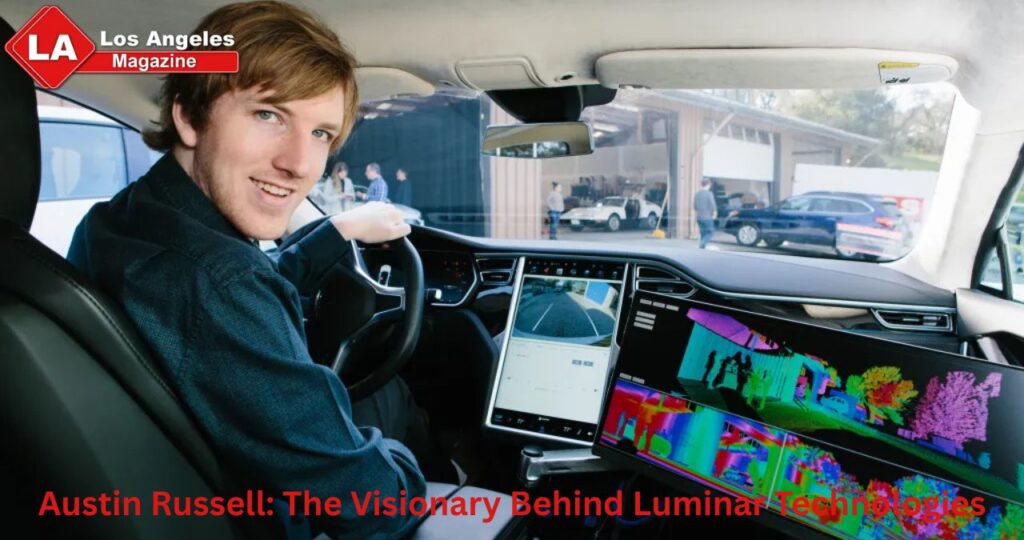

Austin Russell, the young entrepreneur and visionary behind Luminar Technologies, has emerged as one of the most influential figures in the field of autonomous vehicles and lidar (Light Detection and Ranging) technology. As the CEO and founder of Luminar, Russell has revolutionized the way the automotive industry looks at sensor technology, paving the way for safer and more efficient self-driving cars. This article explores the life, achievements, and innovative contributions of Austin Russell, along with the pivotal role Luminar Technologies plays in the advancement of autonomous driving.
Early Life and Education
Austin Russell was born in 1995 in the United States. His journey into the world of technology and entrepreneurship began early. Russell exhibited an interest in science and technology from a young age, and by the time he was 17, he had already made significant strides in his academic career. He enrolled at Stanford University to study physics, where his intellectual curiosity led him to explore cutting-edge fields such as optics and sensing technology. His academic achievements and passion for innovation would later propel him to start one of the most successful tech companies in the autonomous vehicle space.
At Stanford, Russell’s research focused on advanced technologies in optics and how they could be applied to improve sensors used in self-driving cars. His fascination with autonomous driving systems and their potential to transform transportation led him to the realization that lidar technology could be the key to unlocking the true potential of self-driving vehicles. This insight became the foundation of his groundbreaking work and set him on the path to establishing Luminar Technologies.
Founding Luminar Technologies
In 2012, at the age of 17, Russell dropped out of Stanford University to start his own company, Luminar Technologies. His goal was simple yet ambitious: to create high-performance lidar sensors that would enable self-driving cars to see the world with unparalleled clarity and precision. Luminar’s focus was on developing lidar sensors that would provide long-range, high-resolution capabilities, crucial for the safety and reliability of autonomous vehicles.
The decision to pursue this venture was not an easy one. At the time, the lidar industry was still in its infancy, and the technology was far from perfect. Russell, however, was determined to overcome the challenges and bring his vision to life. He took the leap into entrepreneurship, funding the company through his own savings and a few early investors who believed in his vision.
Luminar’s Breakthrough Technology
Lidar technology plays a critical role in autonomous vehicles by helping them navigate the world around them. It works by emitting laser beams and measuring how long it takes for the beams to bounce back after hitting objects, creating detailed 3D maps of the surrounding environment. This information allows autonomous vehicles to detect obstacles, pedestrians, and other vehicles with high accuracy.
Luminar’s breakthrough technology is its ability to create a lidar sensor that offers greater range and resolution than what was previously available. Most traditional lidar systems had limitations in terms of range, often only functioning within a few hundred meters. Luminar’s lidar sensors, on the other hand, offer a much longer range—up to 250 meters—allowing autonomous vehicles to detect objects from farther away and with more accuracy. This breakthrough significantly enhances the safety and reliability of self-driving cars, making them more viable for real-world deployment.
One of the key innovations behind Luminar’s lidar technology is the use of a novel design that integrates advanced optics and sensors into a compact and affordable package. This design allows the company to produce high-quality lidar sensors that are not only cost-effective but also scalable for mass production. The affordability of Luminar’s sensors has been a game-changer for the industry, as it has made lidar technology accessible to automakers and self-driving startups alike.
Strategic Partnerships and Industry Recognition
Under Russell’s leadership, Luminar Technologies quickly gained recognition within the autonomous driving industry. The company’s cutting-edge lidar sensors attracted the attention of major automotive players, including Volvo, Toyota, and Daimler. Luminar secured strategic partnerships with these companies, allowing it to integrate its lidar technology into their autonomous vehicle systems.
In 2020, Luminar made headlines by becoming a publicly traded company through a merger with a special purpose acquisition company (SPAC). The move helped raise significant capital, enabling the company to accelerate its research and development efforts and expand its operations. The IPO was a major milestone for Russell and Luminar, as it marked the company’s transition from a startup to a publicly traded leader in the lidar industry.
Austin Russell’s contributions to the field have also earned him widespread recognition. In 2021, he was named one of the youngest self-made billionaires in the world, thanks to the success of Luminar Technologies. His innovative work has been praised for its potential to reshape the future of transportation, with many experts predicting that lidar will be an essential component of autonomous vehicles in the coming years.
The Future of Autonomous Driving and Luminar’s Role
As the world moves closer to a future where self-driving cars are commonplace on the roads, Luminar Technologies is well-positioned to be a key player in the industry’s evolution. Austin Russell’s vision for the company goes beyond just developing lidar sensors; he is committed to creating a safer, more efficient transportation system that will ultimately benefit society as a whole.
The role of lidar in autonomous vehicles cannot be overstated. While cameras, radar, and other sensors are essential components of self-driving systems, lidar provides the most accurate and detailed 3D mapping of the environment, which is crucial for safe navigation. As autonomous vehicles continue to evolve, the demand for high-performance lidar sensors will only grow, and Luminar is poised to meet this demand.
In addition to its work with traditional automakers, Luminar has also begun exploring opportunities in other industries, such as robotics, industrial automation, and infrastructure. The company’s lidar technology has a wide range of applications beyond autonomous driving, and Russell sees significant potential for expansion into these areas in the coming years.
Austin Russell’s Impact and Legacy
Austin Russell’s story is one of innovation, resilience, and vision. From his early days at Stanford University to founding Luminar Technologies and becoming one of the youngest self-made billionaires, Russell has demonstrated a remarkable ability to turn his ideas into reality. His work has not only advanced the field of autonomous driving but has also contributed to the broader push for safer, more sustainable transportation.
As Luminar continues to grow and innovate, Austin Russell’s impact on the world of technology and transportation will be felt for years to come. His commitment to creating a future where autonomous vehicles are safe, reliable, and widely available is shaping the way we think about the future of mobility. Austin Russell’s legacy as a trailblazer in the lidar industry and the autonomous vehicle space is secure, and his story serves as an inspiration for future generations of entrepreneurs and innovators.
In conclusion, Austin Russell’s journey is a testament to the power of vision and perseverance. Through his leadership at Luminar Technologies, he has played a pivotal role in advancing the capabilities of autonomous vehicles and reshaping the future of transportation. His work continues to inspire and influence the tech industry, and Luminar’s groundbreaking lidar technology will likely remain a cornerstone of autonomous driving for years to come.