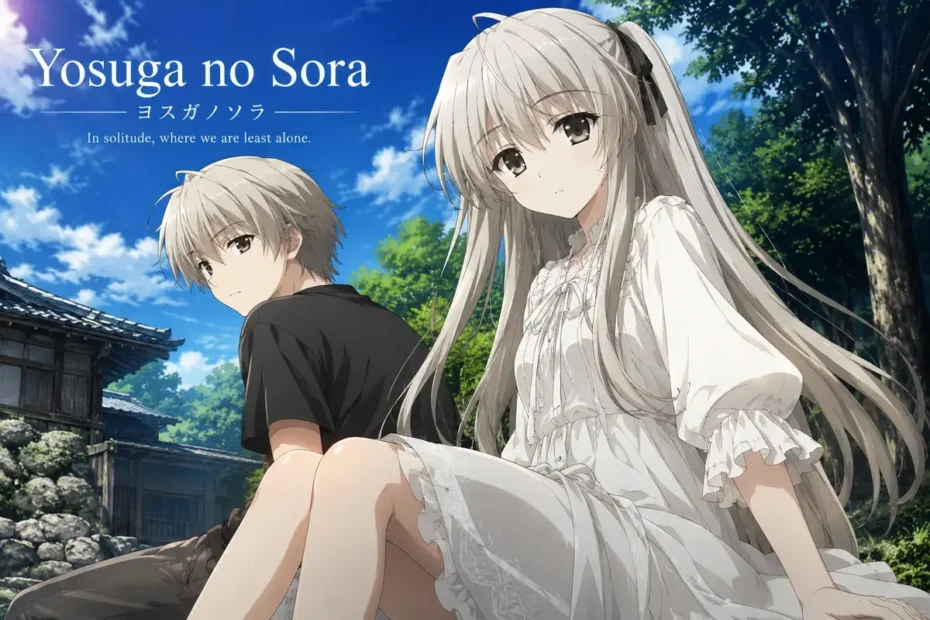
Finding reliable information about Yosuga no Sora feels impossible. Fan wikis contradict each other, and most guides ignore the original visual novel entirely. In the end, you are even more perplexed than before. This guide solves that problem by covering every character route, anime episode, and story detail in one clear resource.
What Is Yosuga no Sora and Why Does It Stand Out?
Yosuga no Sora is a Japanese visual novel developed by Sphere and released in December 2008. The story follows Haruka Kasugano and his twin sister Sora as they return to their late grandparents’ rural home in Okukozome.
The game grabbed attention fast for its branching narrative and emotionally heavy themes. Unlike typical romance titles, it pushes boundaries by exploring taboo relationships alongside genuine character growth.
Sphere, a brand under VisualArt’s, built the game using the Siglus engine. This technical foundation gave the visual novel smooth animations and detailed character sprites that still look sharp today.
Who Are Yosuga no Sora’s Principal Characters?
The cast drives every emotional beat in the story. Each heroine connects to Haruka through shared history, and their individual struggles shape the narrative direction.
- Haruka Kasugano: The male protagonist who returns to Okukozome after losing both parents. He carries a quiet sense of responsibility that defines every interaction.
- Sora Kasugano: Haruka’s frail twin sister who battles chronic illness and deep attachment to her brother. Her route became the most discussed in the entire series.
- Kazuha Migiwa: A childhood friend with a sharp tongue and hidden vulnerability. She wrestles with family pressure and unspoken feelings.
- Nao Yorihime: Another childhood friend whose cheerful exterior masks painful memories tied to the Kasugano family.
- Akira Amatsume: A shrine maiden with a gentle personality and strong ties to local traditions.
- Motoka Nogisaka: A reserved upperclassman whose route explores quieter, more introspective themes.
How Does the Yosuga no Sora Visual Novel Work?
The game follows a branching path system common to visual novels. Players read through text-based scenes, view character sprites and backgrounds, and make choices at key moments that determine which heroine’s route they enter.
Each route runs independently. You restart the story from the beginning to experience a different character’s arc. This structure lets Sphere give every heroine a complete, self-contained narrative instead of rushing through shared events.
The original release included four main routes. A fan disc titled Haruka ni Aogi, Uruwashi no later expanded the universe with additional scenarios and deeper character exploration (VNDB, 2024).
What Are the Different Story Routes Available?
Understanding the route structure helps you appreciate what makes this visual novel different from standard romance games.
| Route | Heroine | Core Theme | Emotional Intensity | Approximate Play Time |
| Kazuha Route | Kazuha Migiwa | Family duty vs. personal desire | Moderate | 8–10 hours |
| Akira Route | Akira Amatsume | Tradition and belonging | Moderate | 7–9 hours |
| Nao Route | Nao Yorihime | Childhood guilt and forgiveness | High | 9–11 hours |
| Sora Route | Sora Kasugano | Forbidden attachment and identity | Very High | 10–12 hours |
| Motoka Route | Motoka Nogisaka | Loneliness and quiet connection | Moderate | 6–8 hours |
Each path demands a fresh playthrough, which rewards patient players with layered storytelling and new details they missed the first time.
How Does the Anime Adaptation Compare to the Game?
The anime premiered in October 2010 and ran for 12 episodes. Studio Feel handled the animation, and the series took a bold structural approach that set it apart from other adaptations (MyAnimeList, 2024).
Instead of picking one route, the anime adapted multiple heroines’ arcs in an omnibus format. Episodes 1–4 cover Kazuha, 5–6 cover Akira, 7–9 cover Nao, and 10–12 cover Sora. Each arc resets the timeline while keeping earlier events as shared backstory.
This format confused viewers on first watch. The timeline jumps require attention, but the payoff is a more complete adaptation than most visual novel anime achieve.
What Makes the Soundtrack So Memorable?
The music in both the game and anime carries enormous emotional weight. Composer Bruno Wen-li (Manabu Miwa) created a piano-driven score that matches the rural, melancholic setting perfectly.
The opening theme “Hiyoku no Hane” by eufonius sets a wistful tone from the first scene. Tracks like “Old Memory” and “Deep Inside Region” use sparse instrumentation to amplify quiet character moments.
Fans consistently rank the soundtrack among the best in the visual novel medium. The music does heavy lifting during scenes where dialogue alone would fall flat.
Why Did Yosuga no Sora Spark Controversy Among Fans?
The Sora route addresses an incestuous relationship between the twin protagonists. This subject matter divided the fanbase immediately upon release and continues to generate heated debate.
Critics argue the anime’s final arc sensationalizes the topic without sufficient narrative justification. Supporters counter that the story treats the relationship with genuine emotional complexity rather than pure shock value.
The controversy actually boosted visibility. Search interest spiked after the anime aired, and the title became one of the most recognized names in the adult visual novel space.
What is the right order to watch the anime?
New viewers often ask about watch order because the omnibus format breaks from linear storytelling. The simplest approach follows the broadcast sequence.
- Episodes 1–4: Kazuha Arc
- Episodes 5–6: Akira Arc
- Episodes 7–9: Nao Arc
- Episodes 10–12: Sora Arc
Each arc resets to the summer arrival in Okukozome but diverges based on which heroine Haruka grows closest to. Watching in broadcast order preserves the intended emotional escalation, with the Sora arc serving as the climactic finale.
How Does the Series Handle Emotional Storytelling?
Sphere built the narrative around loss, isolation, and the search for belonging. Haruka and Sora arrive in Okukozome grieving their parents, and every character they meet carries a parallel wound.
The writing avoids melodrama in most routes. Small moments — a shared meal, a walk through rice fields, a hesitant confession — carry more weight than dramatic confrontations. This restraint makes the heavier scenes hit harder when they arrive.
The rural setting functions as a character itself. Okukozome’s quiet streets, empty shrine grounds, and cicada-filled summers create an atmosphere of beautiful loneliness that permeates every scene.
Where Can You Play or Watch Yosuga no Sora Today?
The visual novel remains available through Japanese digital storefronts and physical copies on auction sites. An English fan translation patch exists for the PC version, though no official localization has been released.
The anime streams on select platforms depending on your region. Availability shifts frequently, so checking current listings on services like Crunchyroll or HiDive gives you the most accurate information.
Physical Blu-ray and DVD sets circulate through import retailers. The complete box set includes all 12 episodes plus bonus OVA content.
What Are the Key Differences Between the Game and Its Fan Disc?
Haruka ni Aogi, Uruwashi no serves as a fan disc that expands the original game’s universe. Released in 2009, it adds new scenarios, extended endings, and deeper exploration of side characters (Sphere / VisualArt’s Official Catalog).
The fan disc also includes a separate story featuring different protagonists set in the same world. This gives returning players fresh content while maintaining the tone and setting they already love.
Think of the original game as the main course and the fan disc as the extended dessert. Both stand on their own, but together they form a more complete picture of Okukozome and its residents.
Is This Series Worth Your Time in 2025?
The visual novel holds up remarkably well for a 2008 release. The writing, character development, and branching structure offer more depth than many modern romance titles.
The anime adaptation remains a divisive but fascinating watch. Its omnibus format was ambitious for 2010, and the production quality from Studio Feel still looks clean on modern displays.
If you enjoy character-driven stories set in rural Japan with genuine emotional stakes, this series deserves a spot on your list. Approach it with an open mind and patience for slower pacing.
Start Your Journey Through Okukozome
Yosuga no Sora earned its place in visual novel history through bold storytelling and unforgettable characters. Whether you dive into the game’s branching routes or watch the anime’s ambitious omnibus format, Okukozome has a story worth experiencing. Pick a route, press start, and let the summer unfold — then share your favorite arc with the community below.